1300
Antique Italian Embroidery
17th Century
Velvet Embroidery with a silver thread and very unique Chenille
work.
This magnificent
velvet emroidery was made for Habsburg Dynasty Proserpina with
husband Pluto.
PROVENANCE:
Ida Jolles ..Nov 23/1899 July 26/1990
PROSERPINA
Circa 1650
Size 84 " x 60"
Size 214 x 153cm
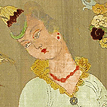
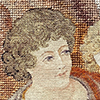
Details Images Top & Below
Italian Textile
History
The myth, She is the Roman equivalent of Persephone. Her name comes from proserpere meaning "to emerge". She was the daughter of Ceres (Greek, Demeter) and Jupiter (Greek, Zeus), who were brother and sister. Proserpina was in Sicily, at the fountain of Aretusa near Mount Etna, when Pluto (Greek, Hades) came out from the underworld stricken with love from an arrow ordered by Venus, (Greek, Aphrodite) and abducted Proserpina in order to marry her and bring her to live in his Kingdom, the Underworld, of which she became Queen. Her mother Ceres, the Goddess of grain and of the Earth, was devasted and went looking for her daughter, but to no avail. In her desparation, Ceres angrily stopped the growth of fruits and vegetables on the Earth. Worried, Jupiter sent Mercury (Greek, Hermes) to order Pluto (Jupiter's brother) to free Proserpina. Pluto obeyed, for he had made her eat pomegranate seeds (symbol of fidelity in marriage). For every seed she had eaten during her stay in the Underworld, she would have to return for a month each year. She had eaten six, and for six months she must return to Pluto, and for the remaining months, be reunited with her mother, Ceres. So this is the reason for Spring and Summer: when Proserpina comes back to her mother, Ceres decorates the Earth with welcoming flowers and warms it with sunshine; but when Proserpina returns to her husband, Ceres brings the cold and bare Fall and Winter.
The Latin Inscription reads, "Six months with her Beloved husband Pluto".
From 1914 to 1918, the noble and wealthy families of the Habsburg Empire sold their art collections and things of worth because of WW I. As the war dragged on for nearly 4 1/2 years all the major European powers had to restructure their economies in order to fight an industrialised "total war" of attrition. Things of great value were bought cheap, art and luxury items were no longer valuable in a collection. Family heirlooms and keepsakes were sold to in order to maintain an amount of wealth. At this time, one of the only groups of people sustaining their wealth and influence were the Jews. Ida Jolles, a Jewish needlepoint factory owner probably purchased these things in Vienna at a a fraction of its value from one of these noblemen within the Habsburg family. Thus, these tapestries passed from their intended royal owners to a wealthy Jewish woman.
These tapestries deal with the marriage of a man and a woman and the woman's submittion to her husband as lord and god. In the Habsburg Empire marriage was held in very high regard, being the sole way they preserved their family's power. Women who married into the Habsburg families were marrying noblemen, kings, princes and dukes, and were to live according to their husband's word. These tapestries acknowledge that concept and were probably given as gifts to a lord or king and his wife for their wedding.
The griffin is associated with Justice and also with the sun. Along the top of the tapestries are the griffins with full bodies, probably symbolizing the God Apollo, or just the concept of light and truth. The Griffins appearing on the bottom of the tapestries, like the one shown above, are vegetale, or still and are growing vines and flowers from their bodies; this relates more to the other side of Apollo, Dionysis. Dionysis signifies rebirth and life. But also Nemesis, which is not all together bad, it only means 'you get what you deserve'. Nemesis is ultimately fate.
The design of the crown embroidered onto both of these pieces may shed some further light on the origin of them. The presence of cornocopias is symbolic of bounty and wealth. It's probable that its meaning on these tapestries is a wish of good luck and prosperity.
Ida Jolles
One of the happiest passengers who sailed early yesterday for Europe on the Hamburg-American liner New York was Mrs. Ida Jolles, who succeeded while here in getting the Treasury Department to reduce the tariff on petit-point, done by a society of women in Vienna who have been left in reduced circumstances by the World War.
"The new tariff raised the duty on this needlework art to 95 per cent which completely killed the industry," she said, "and the 3,000 members lost their incomes. I explained this to the Secretary of the Treasury in Washington and after a discussion and looking into the matter carefully he had the duty reduced to 40 per cent, which is 20 per cent less than it was before, so that I am returning to Vienna very happy to carry the good news.
"Many of the members who do this work belong to the old Austrian aristocracy. The treasury made the reduction because petit-point is a piece of art."
Mrs. Jolles, head of the society, brought a letter from the Treasury Department to the Appraiser here, informing him of the reduction in the tariff on the work.
Another passenger on the New York was Vladimar Shavitch, conductor for the past seven seasons of the Syracuse Symphony Orchestra, who is going to the State Opera House in Moscow for his fourth season. He was born in Russia and is now a citizen of the United States. His wife and their daughter Boliva accompanied him.
Mrs. Ida Jolles Kohlberg, widow of Joseph Jolles, a needlepoint manufacturer, and of Alfred Kohlberg, the anti-Communist importer who was known as "head of the China lobby," died Saturday in her home at 29 East 64th Street. She was 71 years old. Before World War II, she was decorated by the Austrian Government for her work in international trade. She and Mr. Jolles founded a needlepoint industry that employed more than 10,000 persons and spread to Czechoslovakia, Belgium, the Madeira Islands and China. She lived in the United States during World War II, then returned to her native Vienna to help re-establish Austrian industry with Marshall Plan aid. Mr. Jolles, whom she had married in 1919, died in 1941. She was married to Mr. Kohlberg in 1956.